
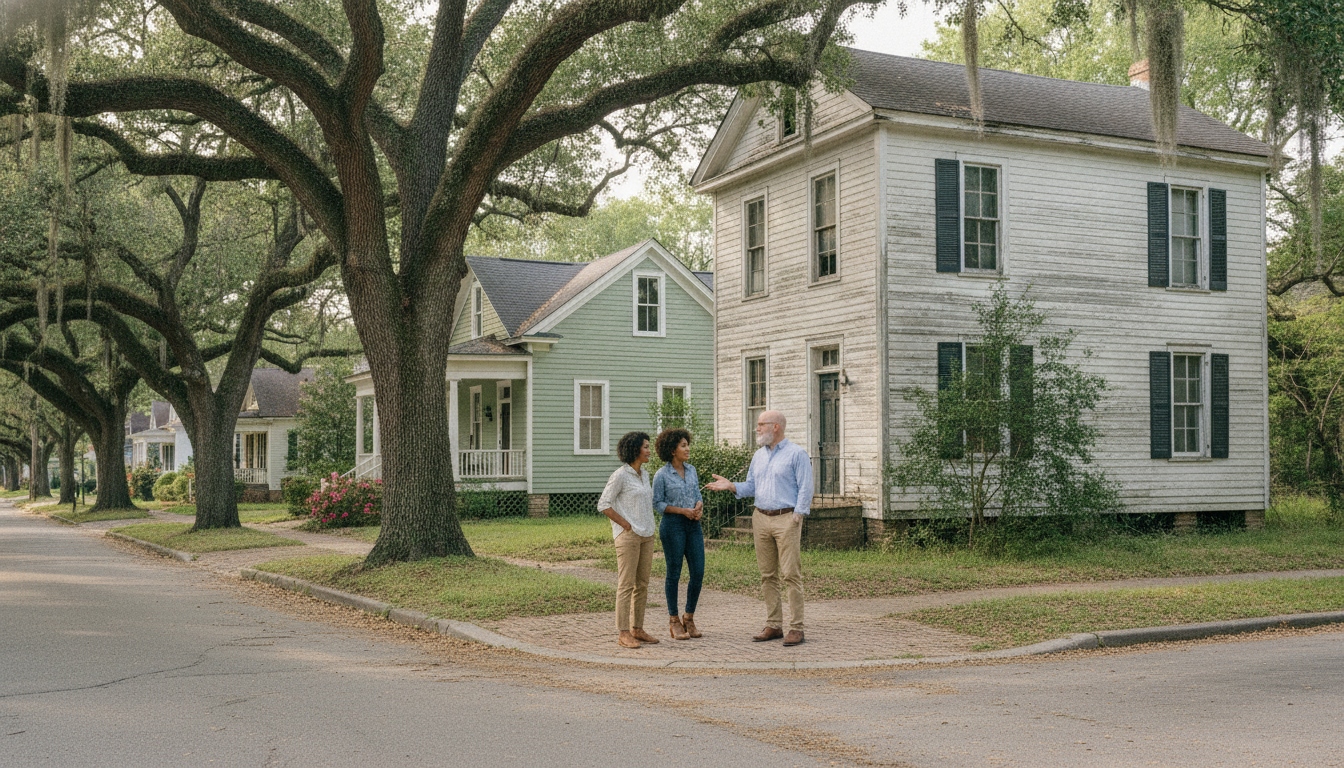
Louisiana Amendment 10 Blighted Property Tax Exemption
Louisiana Amendment 10 property tax relief for rehabilitated blighted properties is on the November 3, 2026 statewide ballot, and if approved, it would authorize parishes across Greater Baton Rouge to offer up to a 75% assessed-value exemption on qualifying residential properties for up to 20 years. The exemption is optional, meaning each parish or municipality would need to pass its own resolution before any local investor or homeowner could benefit. For investors eyeing distressed properties in East Baton Rouge, Ascension, Livingston, or West Baton Rouge parishes, the amendment could meaningfully shift the math on rehabilitation projects that currently pencil out poorly.
What Is Louisiana Amendment 10 and What Would It Do?
Louisiana Amendment 10, formally titled the Tax Exemption for Rehabilitated Property Amendment, began as House Bill 214 (HB 214), introduced by State Representative Chance Henry (R-42) and prefiled in February 2026. The bill earned strong bipartisan support, passing the Louisiana House 80–12 on April 20, 2026, and the Louisiana Senate 33–2 on May 19, 2026, before being placed on the November 3, 2026 statewide ballot.
If voters approve it, the amendment would add a new subsection to Article VII, Section 21 of the Louisiana Constitution, creating the legal authority for an ad valorem (property) tax exemption on rehabilitated blighted or derelict properties. Critically, the amendment itself does not create the exemption automatically — it authorizes the framework, and the resulting program is optional for individual parishes and municipalities.
The Louisiana Legislature has already enacted companion implementing legislation — House Bill 217 (HB 217), signed into law on May 29, 2026 — that establishes the exemption's structure. That law takes effect January 1, 2027, but only if voters approve Amendment 10. Under the enacted implementing statute, the exemption framework would work as follows: residential properties that have been officially designated blighted or derelict and subsequently rehabilitated could qualify for an exemption of up to 75% of assessed value for a period not exceeding 20 years. Adjacent unimproved lots could qualify for up to 25% of assessed value for up to 10 years, with a limit of two such lots per property owner. Because the implementing statute's definitions and procedures only take effect upon voter approval, investors should confirm the law's current status and consult a Louisiana real estate attorney and tax professional before structuring any project around this exemption.
How the Optional Exemption Could Affect Greater Baton Rouge Investors
For real estate investors in Greater Baton Rouge, the financial logic of rehabilitating a blighted property often breaks down at the carrying-cost stage. Acquisition prices on distressed properties may be low, but renovation costs, holding costs, and ongoing property taxes can make the numbers unworkable — especially in neighborhoods where post-renovation appraised values remain modest. A 75% assessed-value exemption held for up to 20 years would substantially reduce that ongoing tax burden, potentially making projects viable that would otherwise be passed over.
The exemption is not automatic. Even if Amendment 10 passes statewide on November 3, 2026, an investor in, say, East Baton Rouge Parish or Ascension Parish would need their local governing body to pass a resolution adopting the program. The enacted implementing statute (HB 217) establishes the framework, but each parish must still opt in and establish its own application process, rehabilitation standards, and approval criteria before any exemption can be granted locally.
Investors should also be aware that a separate incentive — the Restoration Tax Abatement (RTA) — already exists for renovations in certain designated districts in Louisiana. How Amendment 10's new exemption would interact with the RTA, or whether properties could qualify for both, is a question that a tax professional and real estate attorney familiar with Louisiana property tax law should evaluate before structuring any investment around either program.
For investors tracking opportunity in Greater Baton Rouge's distressed property market, the November 3 vote is a meaningful date to watch — but it is the beginning of a local implementation process, not the end of one.
Practical Decision Points for Buyers and Investors Before the Vote
The gap between a constitutional amendment passing and an investor actually receiving a tax exemption involves several steps, and understanding that sequence is important for anyone building a business case around this incentive.
First, the amendment must pass on November 3, 2026. Bipartisan legislative support — 80–12 in the House and 33–2 in the Senate — suggests broad political backing, but voter approval is not guaranteed.
Second, the enacted implementing statute (HB 217, signed May 29, 2026) takes effect January 1, 2027, contingent on voter approval. That law defines 'blighted property' as any immovable property that has been declared or certified as blighted and declared a public nuisance by a court of competent jurisdiction or an administrative hearing officer. It separately defines 'derelict property' as any building or structure that is structurally unsafe, lacks adequate egress, constitutes a fire hazard, is otherwise dangerous to human life, or constitutes a hazard to public safety, health, or welfare by reason of inadequate maintenance, dilapidation, obsolescence, fire hazard, or abandonment. These definitions apply if the amendment passes; a Louisiana real estate attorney can help investors understand how the designation process works in a specific parish.
Third, individual parishes and municipalities must pass resolutions to opt into the program and establish their own application processes, rehabilitation standards, and approval criteria. Investors should begin monitoring parish council agendas and economic development discussions in East Baton Rouge, Ascension, Livingston, and West Baton Rouge parishes to gauge local appetite for adoption.
Fourth, properties must be officially designated as blighted or derelict through whatever process the local jurisdiction establishes — this is not a self-certification. Investors who identify candidate properties now should document the property's condition, research its tax and title history, and understand the local condemnation or nuisance-declaration process. A real estate attorney with Louisiana property law experience is the right professional to guide that due diligence.
Questions to Ask and Professionals to Consult
Because Amendment 10 creates a constitutional framework that still requires local parish adoption and individual project qualification, the most productive thing an investor or homeowner can do right now is build the right advisory team and ask the right questions — not assume the exemption will be available on a specific timeline or in a specific form in their target parish.
Questions worth raising with a Louisiana real estate attorney include: How does the official blighted or derelict designation process work in my target parish? What title and lien issues are common with tax-adjudicated or condemned properties, and how are they resolved? How would this exemption interact with existing incentive programs like the RTA if my project is in a qualifying district?
Questions for a licensed CPA or tax advisor include: How would a multi-year assessed-value exemption affect the overall return on this project? Are there depreciation, basis, or other tax considerations that interact with a property tax exemption? What records and documentation should I maintain to support an exemption application?
Questions for the parish assessor's office and planning or code enforcement department include: How many properties in this area are currently on the condemnation or nuisance list? What is the process for a property to receive an official blighted or derelict designation? Has the parish indicated any intent to adopt the optional exemption program if Amendment 10 passes?
As a REALTOR® serving Greater Baton Rouge, I can help investors identify distressed properties, understand neighborhood market conditions, and connect with the right local professionals — but the legal, tax, and eligibility determinations belong with licensed attorneys and tax advisors. If you're watching this space and want to talk through what the market looks like for distressed properties in Greater Baton Rouge right now, I'm glad to have that conversation.

Baton Rouge Home Seller FAQ
What is Louisiana Amendment 10 on the November 2026 ballot?
Louisiana Amendment 10 is a proposed constitutional amendment on the November 3, 2026 statewide ballot. If approved by voters, it would authorize an optional ad valorem (property) tax exemption for blighted or derelict properties that have been rehabilitated. Individual parishes and municipalities would then decide whether to adopt the program locally by resolution. The amendment passed the Legislature with strong bipartisan support — 80–12 in the House and 33–2 in the Senate — before being placed on the ballot. The Louisiana Legislature has already enacted companion implementing legislation (HB 217, signed May 29, 2026) that takes effect January 1, 2027, contingent on voter approval.
How large could the property tax exemption be under Amendment 10?
Under the implementing legislation already enacted by the Louisiana Legislature (HB 217, signed May 29, 2026, effective January 1, 2027 if voters approve Amendment 10), the exemption could cover up to 75% of the assessed value of a qualifying rehabilitated residential property for a period not exceeding 20 years. Adjacent unimproved lots could qualify for up to 25% of assessed value for up to 10 years, with a limit of two such lots per property owner. These figures are drawn from the enacted implementing statute, but the law only takes effect if voters approve Amendment 10 on November 3, 2026. Consult a tax professional for guidance specific to your situation.
Would the exemption automatically apply in East Baton Rouge Parish if Amendment 10 passes?
No. The exemption program is explicitly optional under the amendment's framework. Even if voters approve Amendment 10 statewide on November 3, 2026, each parish or municipality — including East Baton Rouge, Ascension, Livingston, and West Baton Rouge — would need to pass its own resolution to implement the program locally and establish its own application process, rehabilitation standards, and approval criteria. Investors should monitor parish council activity and economic development discussions in their target markets to track local adoption timelines.
What qualifies as a 'blighted' or 'derelict' property under the implementing legislation?
Under the implementing legislation already enacted by the Louisiana Legislature (HB 217, signed May 29, 2026), 'blighted property' is defined as any immovable property that has been declared or certified as blighted and declared a public nuisance by a court of competent jurisdiction or an administrative hearing officer. 'Derelict property' is defined as any building or structure that is structurally unsafe, lacks adequate egress, constitutes a fire hazard, is otherwise dangerous to human life, or constitutes a hazard to public safety, health, or welfare by reason of inadequate maintenance, dilapidation, obsolescence, fire hazard, or abandonment. These definitions take effect only if voters approve Amendment 10 on November 3, 2026. A Louisiana real estate attorney can help investors understand how the designation process works in a specific parish.
How does Amendment 10 differ from the existing Restoration Tax Abatement program?
Louisiana's existing Restoration Tax Abatement (RTA) program provides property tax relief for renovations to existing structures in certain designated districts. Amendment 10 would create a separate, broader framework targeting properties officially designated as blighted or derelict — not limited to specific geographic districts — and would be administered at the parish level through an optional opt-in process. How the two programs would interact, and whether a property could qualify for both, are questions the implementing legislation and local parish rules will need to address. A tax advisor familiar with Louisiana property incentives can help evaluate which program, if either, applies to a specific project.
Sources
- Ballotpedia: Louisiana Amendment 10, Tax Exemption for Rehabilitated Property Amendment (2026)
- Louisiana House of Representatives: 2026 Constitutional Amendment Summaries
- Louisiana Legislature: HB 214 Bill Information
- Louisiana Legislature: HB 217 Enrolled (Implementing Legislation)
- WBRZ: Louisiana Lawmakers Propose Tax Cuts to Battle Blight
- Build Baton Rouge: Tackling Blight
- Louisiana Economic Development: Restoration Tax Abatement
- WBRZ: PAR Releases Guide to Fall 2026 Constitutional Amendments
- Louisiana Secretary of State: 2026 Proposed Constitutional Amendments