
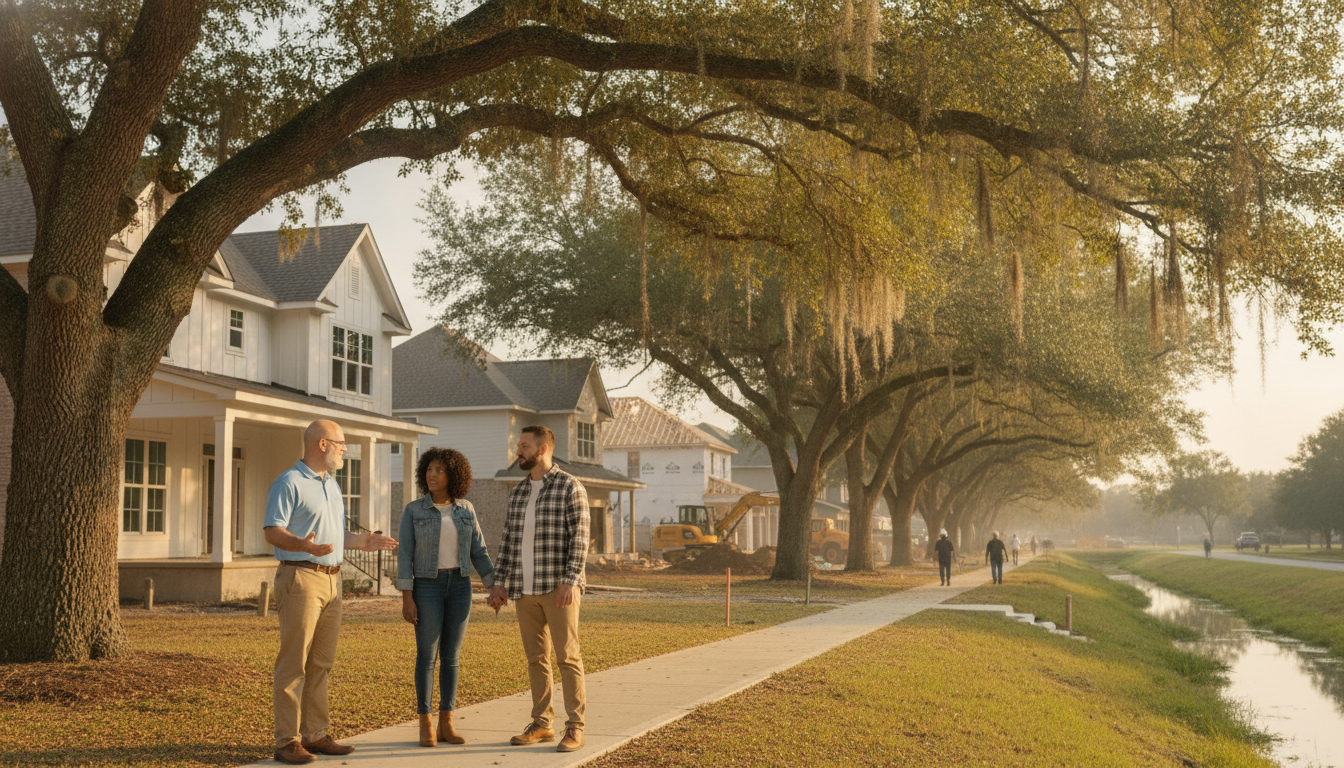
Baton Rouge Job Growth and the 2026 Housing Market
Baton Rouge job growth housing demand is accelerating in late 2026, with the metro reportedly leading Louisiana in employment gains and topping national rankings in construction job growth. Rising buyer demand is pushing median prices higher across East Baton Rouge, Ascension, and Livingston Parishes while inventory remains relatively tight. Relocating buyers who understand which parishes are most competitive—and where new construction is most active—will be better positioned to move quickly when the right home appears.
Baton Rouge Job Growth Housing Demand: What the Numbers Show
For anyone relocating to Greater Baton Rouge, the employment picture heading into late 2026 is one of the strongest the region has seen in years. A July 2026 report by Leaders for a Better Louisiana, based on Bureau of Labor Statistics data, indicates the metro area added approximately 7,900 nonfarm jobs between May 2025 and May 2026, a 1.8% increase that outpaced the prior year's 0.3% gain by a wide margin. That growth rate was described as the largest numerical gain among Louisiana's 10 metropolitan areas and the fastest percentage gain among the state's four major metro areas.
BLS data indicates employment in the Baton Rouge metro reached an all-time high of approximately 440,800 nonfarm jobs in April 2026. According to economist Loren Scott's Louisiana Economic Forecast, presented at the Baton Rouge Business Report's Louisiana Business Symposium, the metro is projected to lead all other Louisiana metro areas in job growth through 2028, driven primarily by large-scale industrial construction investments. At the state level, Louisiana reportedly reached a record 2.01 million nonfarm jobs in May 2026, with Baton Rouge accounting for a leading share of those gains, according to the Leaders for a Better Louisiana Q2 2026 report. According to BLS data, the Baton Rouge metro's unemployment rate was approximately 4.0% in July 2026 (not seasonally adjusted).
For a relocating buyer, these figures matter because sustained job creation—especially at this pace—tends to attract new households, increase purchasing power, and put upward pressure on home prices and competition. Understanding the sectors driving that growth helps you anticipate where demand is likely to remain strongest.
Construction and Tech Sectors: How Each Is Shaping the Market
The construction sector is the clearest story in Baton Rouge's 2026 economy. According to the Associated General Contractors of America (AGC), Baton Rouge ranked first among all 360 U.S. metro areas in percentage increase in construction employment between June 2025 and June 2026, with a reported 22% increase adding approximately 10,200 construction jobs, bringing the total to approximately 57,400. A subsequent AGC analysis covering August 2025 through August 2026 reported approximately 13,300 added construction jobs—a 29% increase—again ranking Baton Rouge first among all U.S. metro areas in percentage growth. According to the Leaders for a Better Louisiana Q2 2026 report, construction was a primary driver of job gains in Louisiana, accounting for approximately 9,300 of the 16,700 jobs added statewide over the prior year as of May 2026.
The projects cited as driving this growth include the Hyundai Steel Mill, CF Industries' ammonia facility, Linde's Air Separation Unit, the I-10 widening project, and over $1 billion in planned state road construction, according to the research sources. Petrochemical and refinery turnaround activity is also cited as a contributing factor in local staffing analyses.
The technology picture is less precisely documented at the local level. Research notes a reported March 2026 expansion by Studyville Enterprises creating approximately 45 positions in the Capital Region, though this figure could not be independently confirmed from a primary source and should be verified directly. Louisiana Economic Development (LED) has highlighted a projected 25% software development job growth rate statewide over a multi-year horizon—verify current projections at opportunitylouisiana.gov, as these figures are subject to revision. Broader state-level initiatives, including a reported multi-billion-dollar AI-focused campus project in Central Louisiana, signal state investment in the sector, though the status and scale of such projects should be confirmed with Louisiana Economic Development directly. Buyers relocating for tech roles should verify current employer-specific hiring plans directly, as the local tech job base is less comprehensively documented than construction.
What This Means for Buyers Relocating to Greater Baton Rouge
The housing market consequences of Baton Rouge's job growth are visible across multiple data points. According to local market reports compiled through mid-2026, the Greater Baton Rouge market saw pending sales and closed sales increase year-over-year, while inventory tightened and months of supply fell. The Greater Baton Rouge Association of REALTORS® (GBRAR) is the authoritative source for current parish-level figures; specific percentages and median prices cited in research reports can shift month to month and should be verified against the most current GBRAR data at the time of your search. According to reporting by The Advocate citing GBRAR data, new home construction across Greater Baton Rouge fell approximately 11% in the prior year, compressing supply at a moment when demand is rising.
For relocating buyers, this means acting with preparation. Pre-approved financing is essential before touring homes in competitive parishes. In Ascension Parish—where early 2026 local market reports placed the median sale price at approximately $330,000 (a reported 5.3% year-over-year increase) and homes were selling in an average of around 42 days—well-priced listings can move quickly. Verify current Ascension Parish figures with a local agent or GBRAR, as conditions shift. Livingston Parish, which local market reports indicate has led the Capital Region in population growth in recent years, continues to attract buyers seeking more space and relative affordability.
Some September 2026 data from Realtor.com and FRED indicates the median list price for the Baton Rouge metro area was approximately $298,250, with a meaningful share of listings showing price reductions. Homes reportedly took a median of around 74 days to sell in September 2026, according to Realtor.com data. This suggests that while the market remains active, buyers may find more negotiating room on homes that have sat longer—particularly outside the most competitive suburban corridors. All figures should be verified against current MLS data at the time of your search.
Questions, Documents, and Professionals to Engage Before You Buy
Relocating to a market you don't know well requires a team, not just a search portal. Here are the practical steps and questions worth raising before you commit:
**With your lender:** Get fully pre-approved—not just pre-qualified—before you tour homes in Ascension or East Baton Rouge, where competitive listings move in weeks. Ask about loan products suited to new construction timelines if you're considering a builder contract in Zachary, Prairieville, or Denham Springs, since construction loans and builder-preferred lenders carry different terms.
**With a local REALTOR®:** Ask which parishes and subdivisions are seeing the fastest absorption, where new construction inventory is actually available, and what builder incentives are currently on the table. A local agent can also help you understand how job-sector proximity affects neighborhood demand—industrial corridor proximity matters differently to a petrochemical worker than to a remote tech employee.
**With a real estate attorney or title professional:** Louisiana's property law, including community property rules and the Act of Sale process, differs from most other states. A Louisiana-licensed real estate attorney can review purchase agreements, builder contracts, and title commitments. Do not rely on general legal knowledge from another state.
**With a tax professional:** Parish-specific property tax millage rates, the Louisiana homestead exemption, and any applicable special assessment districts vary by location and can meaningfully affect your monthly carrying cost. A CPA or tax advisor familiar with Louisiana law should review your specific situation—this is not a determination a real estate licensee can make for you.
**Documents to gather early:** Two years of tax returns and W-2s or 1099s, recent pay stubs, bank statements, and—if relocating for a new employer—an offer letter. Builder contracts require careful review of escalation clauses, completion timelines, and warranty terms before signing.

Baton Rouge Home Seller FAQ
Is Baton Rouge's job growth actually affecting home prices, or is it just a construction story?
Both. Research through October 2026 shows the construction boom is the dominant employment story—Baton Rouge reportedly led all U.S. metro areas in construction job growth percentage—but the downstream effect on housing is real. Median sale prices rose across East Baton Rouge, Ascension, and Livingston Parishes in early-to-mid 2026, pending sales outpaced prior-year levels, and inventory tightened. Job-driven in-migration increases household formation and purchasing power, which puts pressure on a market where new construction reportedly fell approximately 11% in the prior year. Verify current figures with a local agent or the Greater Baton Rouge Association of REALTORS®.
Which parish is most competitive for buyers relocating to Baton Rouge in late 2026?
Based on local market reports compiled through early-to-mid 2026, Ascension Parish showed among the tightest conditions, with a reported median sale price of approximately $330,000 (up roughly 5.3% year-over-year) and homes selling in an average of around 42 days as of early 2026. East Baton Rouge Parish also showed strong demand, with a reported median near $280,000 and faster-than-prior-year sale times. Livingston Parish offers relatively more affordable entry points and has shown consistent population growth. Conditions shift month to month, so verify current data with a local agent or GBRAR.
Where is new construction most active in Greater Baton Rouge?
Research identifies Zachary, Prairieville, and Denham Springs as among the most active suburban corridors for new home construction in Greater Baton Rouge. These areas attract buyers seeking newer homes, more space, and suburban school districts. Buyers considering new construction should ask builders about current lot availability, completion timelines, escalation clauses, and warranty terms—and have a real estate attorney review any builder contract before signing, as builder agreements are typically written to favor the builder.
Is Baton Rouge's tech sector large enough to drive housing demand on its own?
Based on available research, the tech sector's direct contribution to Baton Rouge housing demand is less precisely documented than construction. Local indicators include a reported EdTech expansion in early 2026 and state-level projections of meaningful software development job growth over the coming decade—verify current projections at opportunitylouisiana.gov. Broader state initiatives signal investment in the sector. Tech is a contributing factor to economic diversification, but construction and industrial activity are the primary documented drivers of current housing demand.
Should I wait for the market to cool before relocating to Baton Rouge?
That is a personal financial decision that depends on your employment timeline, financing situation, and risk tolerance—not something a real estate licensee can answer for you. What the research does show is that Baton Rouge's job growth is projected to continue through at least 2028, according to economist Loren Scott's Louisiana Economic Forecast, which suggests sustained demand pressure. Some late-2026 data indicates modest price softening and more listings with price reductions, which may offer near-term negotiating room. A lender and financial advisor can help you evaluate timing relative to your specific circumstances.
Sources
- Baton Rouge Business Report: Metro Projected to Lead State in Job Growth Through 2028
- Leaders for a Better Louisiana: Second Quarter 2026 Economic Development Report
- Baton Rouge Business Report: Louisiana Reaches 2 Million Jobs as Construction Boom Fuels Growth
- Baton Rouge Business Report: Baton Rouge Leads All U.S. Metros in Construction Job Growth
- WBRZ: Baton Rouge Leads 360 U.S. Metro Areas in Construction Employment Growth
- WBRZ: Baton Rouge Leading State's Metro Areas in Job Growth Over Past 12 Months
- City of Baton Rouge: Mayor-President Edwards Touts Record Job Growth
- BLS: Baton Rouge MSA Economy at a Glance
- AGC: Construction Employment Grows in Just Under Half of Metro Areas (Aug 2025–Aug 2026)
- Baton Rouge Business Report: $1B+ in Planned Road Projects
- Realtor.com: Baton Rouge Real Estate Market September 2026
- Louisiana Economic Development: Technology Sector